Showing posts with label Emily Dickinson. Show all posts

April 29, 2011

Of a Poetess

Of a Poetess

A Confession of an Emily Dickinson Devotee


The shadows speak to her of Him

And everything Divine,

And so she writes in metered hymn
The depth of every sign.

The sun and moon and vaulted skies

Are symbols she will say-
She sees the Meaning they disguise

And writes what they portray.


That Meaning (set in cryptic verse)

Transcends what I can see,

And though I have the poet’s thirst

I cannot be as she:

For God has opened up her sight

To see internal things-

With ease she sees the purer light,

I see it and it stings.


-jwm
Of the Poem (Parameters and a Side Note)

Parameters

Stanza:
Octet
Meter: Alternates between a tetrameter (8 syllables per line), and a trimeter (6 syllables)
Rhyme Scheme: ababcdcd per individual stanza

Note

To say Emily Dickinson is an incredible poet is not saying enough. Of course, and I say this respectfully of her, she’s just as human as the next person.

Here’s the deal, though … her passion and talent for poetry, coupled with her ability to perceive the depths of the transcendental in the exceedingly mundane, is a level scarcely reached by most people (and to give expression of it in verse, rarer still).

She composed roughly 1,800 poems in her lifetime. It was only when she died that those who were close to her came to discover her works. This suggests to me that not only did she care little for accolade, but that she cared for poetry for poetry’s sake. A true poet!Her commitment to poetry is chillingly inspiring. I’ve said this before, and I’ll unhesitatingly say it again: She, above any poet I’ve come to know or study thus far, is what a poet ought to be. She is to poetry what Kierkegaard is to existentialism.

December 10, 2010

Happy 180th Birthday, Emily Dickinson


What an incredible month for poetry December is … Milton's birthday celebrated yesterday, and today Dickinson (1830)! Awesome, awesome stuff!

Many people don’t know this about Emily Dickinson, but she composed roughly 1800 poems that almost nobody in the world knew about … her poetic life was essentially a secret, one that was lived- literally!- in solitude. This means, for me at any rate, that she loved poetry for poetry’s sake- and not for accolade, not for prestige, nor for honor, nor reputation or any of that! She, above any one I’ve come to know or study thus far, is what a poet ought to be.

Now anyone who knows me knows that Milton is my favorite poet, but I feel the truth of this statement deep, deep in my heart: I know of no other poet who is more authentic and more unique than Emily Dickinson. She is to poetry what Kierkegaard is to existentialism. I really, really love her and her works!

Happy birthday, Dickinson …


****

Poem 214: I Taste a Liquor Never Brewed

I taste a liquor never brewed –
From Tankards scooped in Pearl –
Not all the Frankfort Berries
Yield such an Alcohol!

Inebriate of air – am I –
And Debauchee of Dew –
Reeling – thro' endless summer days –
From inns of molten Blue –

When "Landlords" turn the drunken Bee
Out of the Foxglove's door –
When Butterflies – renounce their "drams" –
I shall but drink the more!

Till Seraphs swing their snowy Hats –
And Saints – to windows run –
To see the Tippler
Leaning against the – Sun!

September 14, 2010

Our Lives are Swiss


It's by virtue of our finitude that we find it difficult to envision things beyond a limited perspective- we have our prejudices, our pre-conceptions, our predilections, and so on.

There are times, however, when these biases give way and a broader perception of things is made manifest- as if we're seeing reality from the perspective of eternity.

These are the visions that the mystic seeks- but not just the mystic. Every human has at some point in their existence experienced that which is transcendental, that overwhelming flood of beauty and truth that everyday existence seems to lack ... and even though they may not be able to articulate that experience, they know with certainty that they've tasted the divine.

Myself? - I'm not unfamiliar with these experiences; I've even tried to articulate a few of them in verse (e.g. A Memory of Delta D.O.C.).

One thing I've noticed is that when these did occur with me they were sudden, unexpected, unrelenting, and usually carried with them an intensity that was so aesthetically pleasing that I almost aways fell into a crippling swoon- no exaggeration here.

There's a poem by Emily Dickinson, Our Lives are Swiss, that expresses beautifully experiences such as these.

In it- and this is by no means the only interpretation one can render- in it the life of the Swiss, surrounded by those towering Alps, signifies our limited state of existence as humans. There are times (odd afternoons) that these limitations give way ('The Alps neglect their Curtains') and we see clearly a broader scope of reality; we 'look further on' and behold that which is transcendental ('the other side').

The point of the poem, or at least one of the points I derive, is that there's a broader reality out there; that we ought, insofar as this is possible, to cast aside our prejudices, pre-conceptions, and predilections, so that we might better broaden our perspective of reality and peer, like the mystic, on life from the perspective of eternity.


Our lives are Swiss --
So still -- so Cool --
Till some odd afternoon
The Alps neglect their Curtains
And we look farther on!

Italy stands the other side!
While like a guard between --
The solemn Alps --
The siren Alps
Forever intervene!


August 22, 2010

What Will the Fir-Tree Say*


Beauty provokes thieves sooner than gold.

~Shakespeare~

We spoke yesterday at the pool, briefly, on how urban expansion impinges upon the land that animals know as home. We seem shocked that a red tail fox should be roaming our neighborhoods, or think it odd that there would be rabbits deep in the heart of a city.

And then we have the reality of intermittent animal attacks, and condemn, not our annexation of their natural territories, but their dangerous presence our communities. We usually kill the more dangerous of these, or throw them into captivity; some of the more docile of the creatures, like prairie dog, we simple relocate (which, we say, is usually better than the alternative- but for who I ask).

Expansionism- if ever there were a term more frightening to nature it would undoubtedly be this one. We pillage her recourses like gluttons; exploit her loveliness like careless lovers; and draw from her bosom some of the most lethal, some of the most deadliest uses we have ever known (and we fear the fox).

Later that night I happened to read, for the first time, a poem written by Emily Dickinson entitled, Who Robbed the Woods. It reminded me, though it referred to no animal, of that poolside conversation. As I read it I derived deeper meanings, but its more literal (or closely literal) aspect penetrated my heart deeply: here we have this gorgeous plant (these “woods”) and yet, rapaciously and without consideration, we exploit it; we often not only take this planet’s loveliness for granted, we misuse and destroy her natural beauty to achieve purely anthropocentric ends (and this with little regard).

Of course we need to utilize her resources to sustain life, but don’t we often take this a little too much to the extreme? Is it utterly necessary to hack down entire forests to make our lives easier? Is there not moderation? Must we achieve comfort at the expense of nature and her beauty? Must we take all this wonderment around us for granted?

Then again, have we not all done the same?


Who Robbed the Woods

Who robbed the woods,
The trusting woods?
The unsuspecting trees
Brought out their burrs and mosses
His fantasy to please.
He scanned their trinkets, curious,
He grasped, he bore away.
What will the solemn hemlock,
What will the fir-tree say?


*Painting by Randy Richmond

May 27, 2010

In Reference to the Previous Post

In the name of the Bee—
And of the Butterfly—
And of the Breeze— Amen!

Emily Dickinson

I just read this poem by Dickinson and thought its concluding lines very delightful considering the subject of my previous post. See comments area for the poem in its entirety.

March 24, 2010

Emily's Poem- XIII


XIII

The Soul selects her own Society —
Then — shuts the Door —
To her divine Majority —
Present no more —

Unmoved — she notes the Chariots — pausing —
At her low Gate —
Unmoved — an Emperor be kneeling
Upon her Mat —

I’ve known her — from an ample nation —
Choose One —
Then — close the Valves of her attention —
Like Stone —


Of the Poem:

In line 1 Dickinson uses alliteration as a stylistic device, and does so with wonderful efficiency- notice how the ‘c’ of Society takes on an alliterative quality akin to the smooth sounds produced by the other ’s’ words in the same line (just say it aloud and see: The Soul selects her own Society).

Taken as a whole it seems there’s little evidence the poet intended a specific meter, but there are some similarities between the first two stanzas:

- the first lines of each contain ten syllables
- the second and fourth four
- the third line differs only by an extra syllable


The rhyme scheme, which essentially consists of oblique rhymes, is more tangible: a.b.a.b. with each stanza- provided we postulate a rhythmic relation between Gate and its half rhyme Mat of the second stanza.

Dickinson’s poetic style- from her dashes to her highly creative use of oblique rhyme schemes- has shown her to be one of the most ingenious and original writers I’ve come to know.

She employs some of the most awkward imagery I’ve seen in poetry- but in a most fantastic way, and almost never seems to exhibit academic conformity (which I admire).

The fact that she produced nearly 1800 poems before her death without a single soul knowing about them is clear evidence to me that she loved poetry not for the sake of accolade, but for poetry itself.

Like Theodore Roethke , Emily Dickinson’s poetic authenticity is undeniable. I appreciate her works dearly.


*****

Note: Below in the comments area is one of many perspectives I've flirted with concerning this poem. Although I’m still developing my take on this poem, I thought I’d post some of my current thoughts there. I’d love to know what you think of it.

March 23, 2010

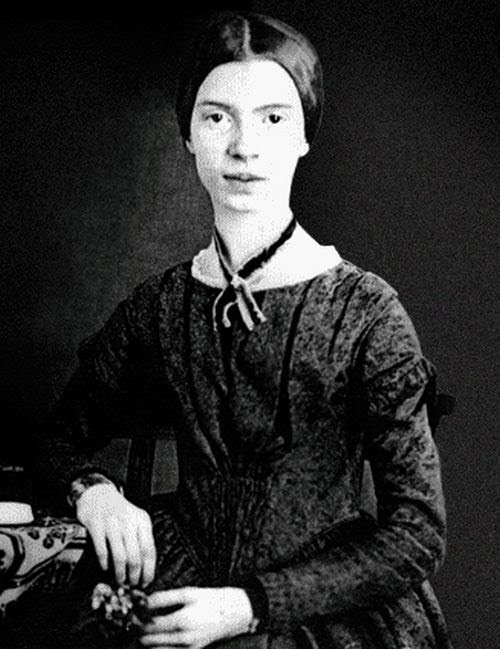
Emily Dickinson*


Emily Dickinson (1830 - 1886)

Emily Dickinson was born in Amherst, Massachusetts, in 1830. She attended Mount Holyoke Female Seminary in South Hadley, but severe homesickness led her to return home after one year. Throughout her life, she seldom left her house and visitors were scarce. The people with whom she did come in contact, however, had an enormous impact on her thoughts and poetry. She was particularly stirred by the Reverend Charles Wadsworth, whom she met on a trip to Philadelphia. He left for the West Coast shortly after a visit to her home in 1860, and some critics believe his departure gave rise to the heartsick flow of verse from Dickinson in the years that followed. While it is certain that he was an important figure in her life, it is not certain that this was in the capacity of romantic love—she called him "my closest earthly friend." Other possibilities for the unrequited love in Dickinson’s poems include Otis P. Lord, a Massachusetts Supreme Court Judge, and Samuel Bowles, editor of the Springfield Republican.

By the 1860s, Dickinson lived in almost total physical isolation from the outside world, but actively maintained many correspondences and read widely. She spent a great deal of this time with her family. Her father, Edward Dickinson, was actively involved in state and national politics, serving in Congress for one term. Her brother Austin attended law school and became an attorney, but lived next door once he married Susan Gilbert (one of the speculated—albeit less persuasively—unrequited loves of Emily). Dickinson’s younger sister Lavinia also lived at home for her entire life in similar isolation. Lavinia and Austin were not only family, but intellectual companions during Dickinson’s lifetime.

Dickinson's poetry reflects her loneliness and the speakers of her poems generally live in a state of want, but her poems are also marked by the intimate recollection of inspirational moments which are decidedly life-giving and suggest the possibility of happiness. Her work was heavily influenced by the Metaphysical poets of seventeenth-century England, as well as her reading of the Book of Revelation and her upbringing in a Puritan New England town which encouraged a Calvinist, orthodox, and conservative approach to Christianity.

She admired the poetry of Robert and Elizabeth Barrett Browning, as well as John Keats. Though she was dissuaded from reading the verse of her contemporary Walt Whitman by rumor of its disgracefulness, the two poets are now connected by the distinguished place they hold as the founders of a uniquely American poetic voice. While Dickinson was extremely prolific as a poet and regularly enclosed poems in letters to friends, she was not publicly recognized during her lifetime. The first volume of her work was published posthumously in 1890 and the last in 1955. She died in Amherst in 1886.

Upon her death, Dickinson's family discovered 40 handbound volumes of nearly 1800 of her poems, or "fascicles" as they are sometimes called. These booklets were made by folding and sewing five or six sheets of stationery paper and copying what seem to be final versions of poems in an order that many critics believe to be more than chronological. The handwritten poems show a variety of dash-like marks of various sizes and directions (some are even vertical). The poems were initially unbound and published according to the aesthetics of her many early editors, removing her unusual and varied dashes and replacing them with traditional punctuation. The current standard version replaces her dashes with a standard "n-dash," which is a closer typographical approximation of her writing. Furthermore, the original order of the works was not restored until 1981, when Ralph W. Franklin used the physical evidence of the paper itself to restore her order, relying on smudge marks, needle punctures and other clues to reassemble the packets. Since then, many critics have argued for thematic unity in these small collections, believing the ordering of the poems to be more than chronological or convenient. The Manuscript Books of Emily Dickinson (Belknap Press, 1981) remains the only volume that keeps the order intact.


*Biography from Poets.org

The Poets

As of April 9th, 2010